
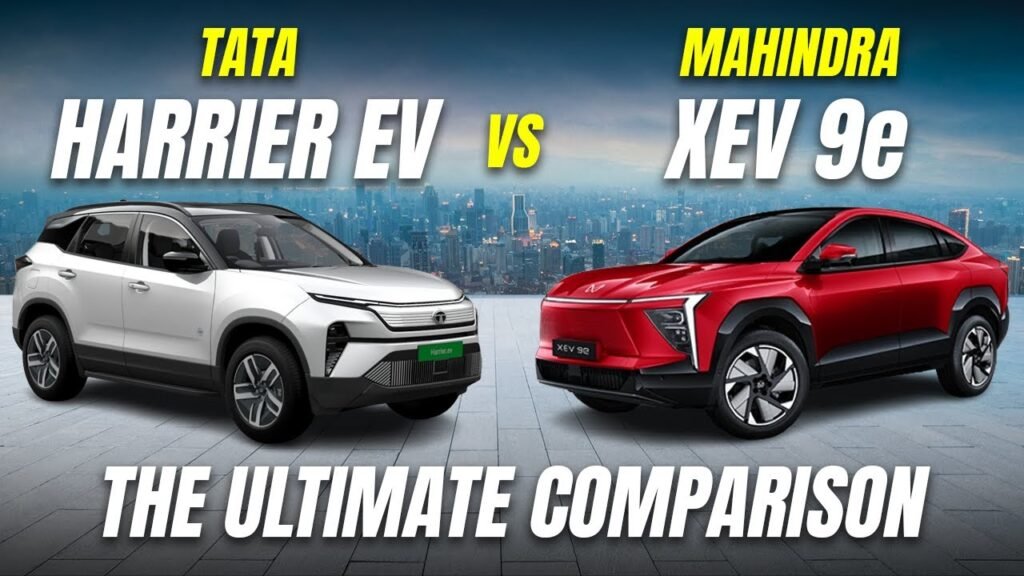
Tata Harrier EV vs Mahindra XEV 9e
Electric SUV Showdown in India
As EV adoption rises rapidly in India, mid-size electric SUVs have become the flagship choices for buyers stepping up from hatchbacks or compact EVs. The Tata Harrier EV and Mahindra XEV 9e are two strong contenders in this segment — one bringing Tata’s proven SUV heritage and tech, the other showcasing Mahindra’s futuristic design and strong range.
📏 Design & Dimensions
Tata Harrier EV carries forward the bold and muscular SUV design language of the Harrier family, with EV-specific tweaks such as a closed-grille and aerodynamic detailing.
Mahindra XEV 9e goes for a more futuristic and sleek coupe-like silhouette, which tends to turn heads and gives a very modern appeal compared to traditional SUV shapes.
On dimensions, the Mahindra is overall longer and has a longer wheelbase; while the Harrier EV is wider and taller, which can translate to a more commanding road presence.
📌 XEV 9e gets a slight edge in peak range and faster DC charging, especially with its larger 79 kWh pack.
📌 Harrier EV’s AC charging can be a bit quicker, and it offers unique EV innovations like vehicle-to-vehicle (V2V) and vehicle-to-load (V2L) support.
⚡ Performance & Drivetrain
One of the biggest differences between the two is the drivetrain and performance approach:
Harrier EV offers both rear-wheel-drive (RWD) and dual-motor all-wheel-drive (AWD) variants. In AWD form, it produces strong combined power (~390 bhp) and over 500 Nm torque, giving brisk acceleration.
XEV 9e currently comes with a single electric motor (RWD) only, with power figures in the ~230-282 bhp range depending on battery.
📊 In real-world testing, the AWD Harrier EV was quicker off the line (0–100 kph) than the Mahindra, even though the Mahindra tops out at a slightly higher top speed on paper.
🪑 Space & Practicality
XEV 9e enjoys more cargo space, offering a generous boot (~663 L) and a large frunk (~150 L), which is great for luggage and daily utility.
Harrier EV’s boot is still respectable (~502 L) but smaller compared to Mahindra’s SUV, and its frunk space is modest in comparison.
The Mahindra’s longer wheelbase also translates into a feeling of more interior space, which families might appreciate on longer trips.
📺 Features & Technology
Both SUVs come loaded with modern tech and safety features, yet their approaches differ:
✔ Harrier EV:
Large 14.5-inch touchscreen (Samsung Neo QLED)
V2L / V2V charging support
ADAS and advanced 360° camera tech
Terrain modes and rugged SUV-oriented tech
✔ XEV 9e:
Triple 12.3-inch screen system (driver + infotainment + passenger display)
Harman Kardon premium audio
Touch-rich digital ecosystem powered by advanced processors
Level 2+ ADAS with multiple cameras and sensors
Both SUVs also score 5-star safety ratings at Bharat NCAP, underlining strong occupant protection.
💰 Pricing & Value
Tata Harrier EV starts at around ₹21.49 lakh (ex-showroom) and goes higher for AWD.
Mahindra XEV 9e is priced from roughly ₹21.90 lakh up to around ₹30.50 lakh (ex-showroom) depending on variant.
Overall, pricing between the two is competitive, with Harrier EV’s AWD variants and top trims overlapping with the higher end of the XEV 9e lineup.
🏁 Final Verdict — Which One Should You Choose?
🔋 Choose Tata Harrier EV if you want:
✔ Powerful performance and AWD capability
✔ Off-road confidence and SUV-like stance
✔ Innovative EV features like V2L/V2V
✔ Slightly sportier acceleration in real conditions
➡ Best for families and drivers who want a feature-packed, performance-oriented, tech-rich SUV experience.
⚡ Choose Mahindra XEV 9e if you want:
✔ Best-in-class range with larger battery option
✔ Bigger boot and frunk space — great for travel/luggage
✔ Futuristic tech-centric cabin with multiple screens
✔ Slightly higher top speed and practicality
➡ Ideal for buyers prioritising range, space, futuristic design and tech.
📌 Summary (Quick Points)
Performance: Harrier EV stands out with AWD and stronger torque; XEV 9e still very capable in RWD form.
Range: XEV 9e has peak range advantage.
Features: Both tech-rich, but with different strengths and screen setups.
Space: XEV 9e wins in cargo and frunk storage.
Value: Competitive pricing, with each offering value in its own way.
🚗 Driving DNA Verdict — Tata Harrier EV vs Mahindra XEV 9e
🔋 Tata Harrier EV — Dynamic & Confident Cruiser
The Harrier EV’s driving personality is assertive, powerful and SUV-centric. Its RWD and available AWD options give it strong acceleration, solid grip and controlled poise, making it feel planted whether you’re cruising on the highway or navigating tighter city spaces.
Acceleration: Brisk and confident, especially in higher-spec / dual-motor variants
Suspension & Ride: Balanced ride that’s firm without being harsh — feels stable at speed
Steering & Dynamics: Precise and communicative, giving a sense of control
Overall Feel: A performance-oriented EV that still retains SUV character — sturdy stance, composed behaviour, and capability
Summary:
🔥 Dynamic, confident and SUV-shaped — made to enjoy both highway cruises and spirited drives.
⚡ Mahindra XEV 9e — Smooth & Futuristic Glider
The XEV 9e isn’t just an EV — it’s a smooth, composed and tech-centric mover. Its electric motor delivers power in a balanced, effortless way, prioritising comfort and serenity over aggressive acceleration.
Acceleration: Linear and relaxed — excellent for city and highway use
Suspension & Ride: Plush ride that absorbs road imperfections well
Steering & Dynamics: Smooth, light and easy — great for everyday urban driving
Overall Feel: A refinement-first drive with futuristic cabin comfort and calm motion
Summary:
✨ Gently refined, easy-going and comfort-oriented — perfect for smooth everyday use and relaxed long trips.